A shopper opens ChatGPT and types "best merino base layer for winter running." ChatGPT thinks for a moment, runs a few searches, and returns a shortlist: three or four brands, a sentence of reasoning for each, sometimes a product card with a price. If your store is on that list, you might get the sale. If it isn't, you never see the miss — there's no impressions report, no rank tracker in Shopify Admin, nothing.
This guide is about how that shortlist gets built, what "ranking" even means inside a system that answers the same question differently every time, and the concrete levers a Shopify merchant can pull. It's the pillar of our Shopify cluster; the deeper mechanics live in How ChatGPT recommends products and ChatGPT shopping for ecommerce brands.
How ChatGPT builds a shopping answer
There isn't one "ChatGPT ranking." A shopping answer is assembled from three different sources, and understanding which one is doing the work in a given answer tells you where to spend effort.
1. Training data (the model's prior)
The base model has read an enormous amount of the public web. When you ask a broad question — "what are good running shoe brands?" — it can answer from memory, no live search required. This favors established brands with years of mentions across reviews, forums, and press. New or niche stores are usually invisible here, and there's no fast fix: you can't retrain the model.
2. Web search (retrieval at answer time)
For anything specific, current, or commercial — prices, availability, "best X for Y in 2026" — ChatGPT runs live searches and reads the results before answering. This is the layer most merchants can actually influence, because it's driven by what's crawlable and citable on the web right now, not by what the model memorized last year. Independent analysis by Profound found that the products surfaced in ChatGPT Shopping map almost entirely onto the top organic Google Shopping results for the same query — and that paid ads are ignored. Your organic product-feed health in Google's ecosystem is, indirectly, ChatGPT visibility.
3. Product feeds and the Agentic Commerce Protocol
The newest layer: a structured product feed supplied directly to OpenAI. Merchants can push a compressed feed (.jsonl.gz, .csv.gz, or .xml.gz) to an OpenAI endpoint describing what they sell, stock status, and price — the same rails that power in-chat checkout via the Agentic Commerce Protocol, an open standard maintained by OpenAI and Stripe. For Shopify stores, this is largely handled for you through Agentic Storefronts (more in the Shopify + ChatGPT integration guide). A direct feed is the difference between ChatGPT inferring your catalog from web pages and knowing it from a source of truth.
Most real answers blend all three: the model's prior narrows the field, web search pulls current candidates and reasoning, and feeds supply the structured product data behind the card.
What "ranking" means when answers are sampled
Here's the part that trips up merchants coming from SEO. In Google, a query has a ranking: you're position 4 for "merino base layer" today, and that's a fact you can look up. ChatGPT is not like that.
ChatGPT's answers are probabilistic. Ask the exact same question ten times and you can get ten slightly different shortlists — different brands, different order, different reasoning. The model samples; the live searches it fires (its query fanout) vary; the pages it happens to read vary. There is no single "rank."
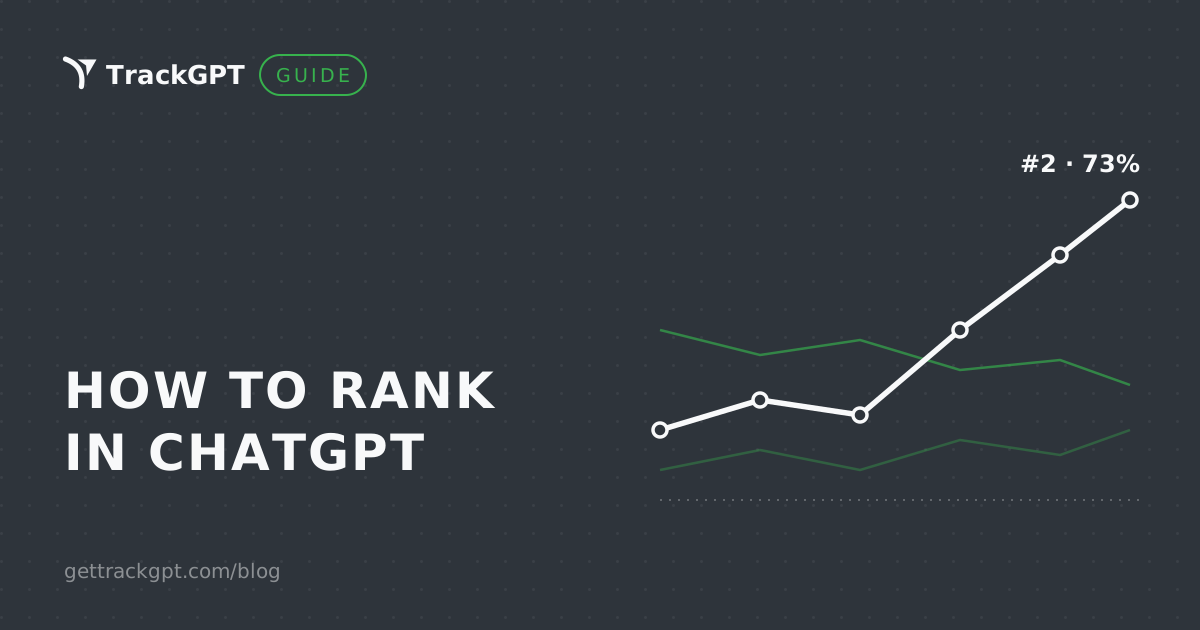
So ranking in ChatGPT is a rate, not a position. The honest way to describe your standing is: across many samples of this question, how often does ChatGPT mention your store, and when it does, where do you sit relative to competitors? A brand that shows up in 8 of 10 answers is winning that prompt. One that shows up in 1 of 10 is contested at best. One that never appears is invisible — and a single lucky mention doesn't change that.
This has a hard consequence: you cannot read your ChatGPT standing from a single answer. Trying one prompt yourself and seeing your brand (or not seeing it) tells you almost nothing — you sampled n=1 from a noisy distribution. Any serious measurement has to sample the same prompts repeatedly over time and report the rate with the sample count attached. It's the whole reason a tool like TrackGPT samples every tracked prompt daily and aggregates to weekly trends rather than reacting to day-to-day wobble.
The factors that correlate with getting mentioned
Nobody outside OpenAI has the ranking function, and OpenAI is explicit that product results are organic — "not ads, nor influenced by any OpenAI partnerships," with no way to pay for placement. But between OpenAI's own guidance, the feed spec, and independent analysis, a consistent set of factors emerges. None are tricks; they're the boring fundamentals, which is good news because they're durable.
Structured, complete product data
ChatGPT rewards machine-readable clarity. On-page, that means complete Product schema JSON-LD — name, brand, price, currency, availability, aggregateRating, GTIN/MPN. In the feed, it means filling every field the spec allows: title (up to 150 characters), a real description (up to 5,000 characters), price with an ISO 4217 currency code, availability, and clean images. Sparse or ambiguous product data is the single most common reason a good product gets skipped — the model can't recommend what it can't confidently parse.
Reviews and third-party authority
ChatGPT synthesizes across sources and leans on signals it can corroborate. Ratings and review counts matter both as structured data and as the raw material for its reasoning ("well-reviewed," "highly rated for durability"). Just as important is off-site validation: being named in "best of" listicles, Reddit threads, YouTube reviews, and press. Unlike classic SEO, these third-party mentions feed directly into the written recommendation, not just a backlink score. See AI SEO for ecommerce for how to build this deliberately.
Category-language match
Query fanout means ChatGPT rewrites the shopper's prompt into specific sub-queries before searching. Broad, generic pages match poorly; pages that speak the customer's exact category language — "packable rain shell for bike commuting," not "outerwear" — match the retrieval. Write product copy and collection pages in the specific, benefit-and-attribute language shoppers actually use, with measurable specifics ("lasts 5 years," "weighs 210g") rather than vague adjectives.
Availability and being the primary seller
OpenAI's own guidance says merchants are ranked on factors including availability, price, quality, and whether you're the maker or the primary seller of the item. In-stock beats out-of-stock. Accurate, real-time inventory and pricing (exactly what an Agentic Storefront feed keeps fresh) protect you from being dropped for a stale listing. Being the brand or authorized primary seller beats being one of fifty resellers of the same SKU.
Presence on the sources ChatGPT cites
Because ChatGPT's product layer tracks organic Google Shopping and the broader web, your visibility there is an input. A healthy Google Merchant Center feed, indexed product pages, and mentions on the review sites and marketplaces ChatGPT tends to cite all raise the odds. This is covered end-to-end in our GEO for ecommerce playbook.
Why you must measure before you optimize
Every factor above is a hypothesis until you can see whether moving it moves your mentions. And because ChatGPT is probabilistic, "did that help?" is genuinely unanswerable by intuition — you need a baseline rate, a change, and a follow-up rate over enough samples to tell signal from noise.
Concretely, before touching your feed or rewriting copy, you want to know: for the 20–50 prompts your customers actually ask, how often does ChatGPT mention you today, who does it mention instead, and are you Winning, Contested, Losing, or Invisible on each? That baseline is the difference between optimizing and guessing. It also protects you from over-reacting: a competitor jumping ahead of you in one answer is noise; a sustained two-week slide is signal.
This is precisely the gap TrackGPT fills. It samples your prompts against ChatGPT every day, records the raw answer text as a receipt so every number traces back to something you can read, ranks you among all detected brands, and aggregates to weekly trends so single-day swings don't cry wolf. It's monitoring, not magic — TrackGPT won't rewrite your theme or auto-tune your feed. It tells you where you stand and whether your changes worked. If you want the tracker specifically, see the ChatGPT rank tracker; for the broader picture, the AI visibility platform.
FAQ
Can I pay to rank higher in ChatGPT?
No. OpenAI states that product results in ChatGPT are organic and unsponsored — "not ads, nor influenced by any OpenAI partnerships." There is no paid placement in the product recommendations today. Any vendor promising guaranteed ChatGPT placement is selling something that doesn't exist. (OpenAI has a separate is_ads_eligible flag in the feed spec, suggesting paid formats may emerge later as a distinct thing — but that would not let you buy the organic ranking.)
How is ranking in ChatGPT different from ranking in Google?
Google gives a query one deterministic position you can look up. ChatGPT samples a fresh answer each time, so your "rank" is really a mention rate across many samples plus your position relative to competitors when you do appear. You measure it statistically, not by checking once.
How long does it take to see changes?
There's no crawl-and-index cadence you can point to, and because answers are probabilistic you need enough samples to detect a real shift. Practically, plan to make a change and watch the weekly trend over 2–4 weeks rather than expecting a next-day jump. Feed and inventory updates (via Agentic Storefronts) propagate faster than reputation signals like reviews and mentions.
Do I need the Agentic Commerce Protocol set up to appear at all?
No — ChatGPT can surface your products from web search and organic Google Shopping data without a direct feed. But a direct feed via Agentic Storefronts gives ChatGPT authoritative, current product data, which correlates with stronger, more accurate placement. See the Shopify + ChatGPT integration guide.
What prompts should I even track?
Start with the questions a real customer would ask on the way to buying what you sell: category shortlists ("best X for Y"), comparison prompts, and use-case prompts. Include your brand name and your top competitors' names too. Twenty to fifty well-chosen prompts covers most stores.
You can't improve what you can't see
Ranking in ChatGPT isn't a dark art — it's structured data, reviews, category language, availability, and third-party authority, measured honestly over many samples. But every one of those levers is a guess until you can watch your mention rate respond. Get the baseline first. Start a free TrackGPT trial, see exactly where ChatGPT places your store against your competitors today, and only then decide what to fix.