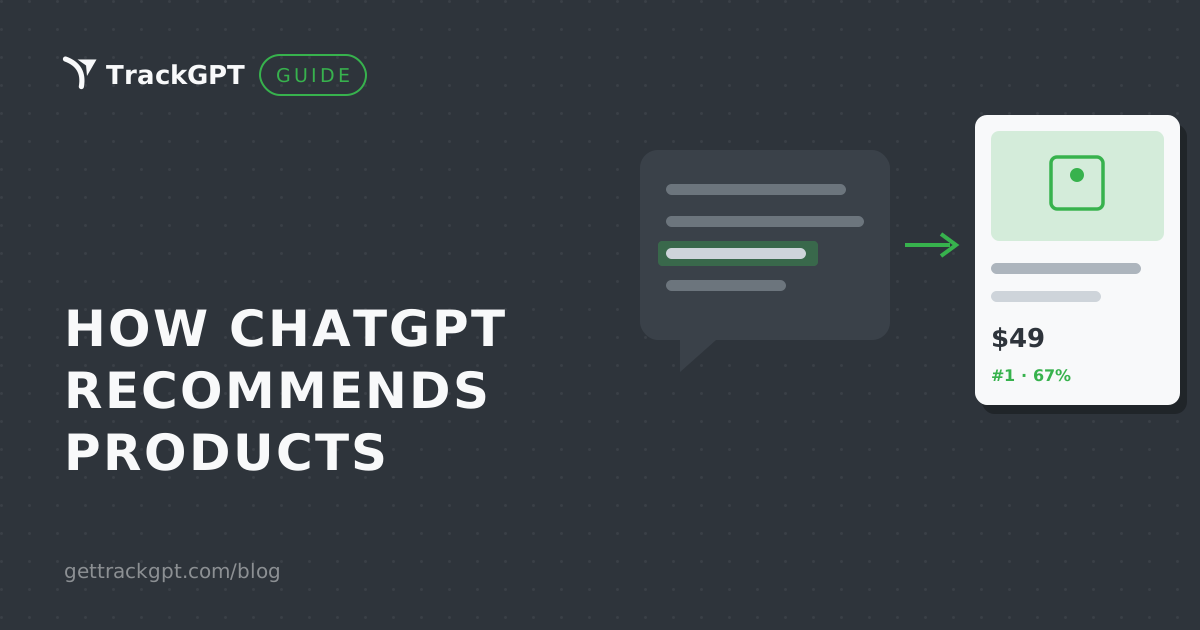
If you want to help ChatGPT discover your products, it helps to know what ChatGPT is actually doing between the moment a shopper hits enter and the moment a shortlist appears. It's not one lookup. It's a small pipeline — decompose, retrieve, read, rank, cite — and each stage is a place your store can be present or absent. This post walks that pipeline for Shopify merchants. For the strategic view, start with How to rank in ChatGPT; for the shopper-facing surface, see ChatGPT shopping for ecommerce brands.
Step 1: Query fanout — one prompt becomes many searches
ChatGPT doesn't pass the shopper's prompt straight to a search engine. It first decomposes the intent into several more specific sub-queries and runs them, a technique the industry calls query fanout. "Best gift for a coffee lover under $50" might fan out into searches for pour-over kits, specialty bean subscriptions, milk frothers, and mugs — each a separate retrieval.
Two facts about fanout matter for merchants. First, analysis of 20 million ChatGPT fanout queries by Peec AI found the average fanout query roughly doubled in length between late 2025 and early 2026 — from about 6 words to about 12. ChatGPT is getting more specific, not just noisier. Second, ChatGPT tends to run relatively few sub-queries per prompt compared to Google's AI Mode — it leans on precision over breadth.
The implication: generic pages lose. If ChatGPT is searching "packable rain shell for bike commuting under 250 grams," a collection page titled "Outerwear" won't match. A product page written in that exact attribute-and-use-case language will. Match the specificity of the fanout, not the broad head term.
Step 2: Retrieval — where ChatGPT looks
For each sub-query, ChatGPT retrieves candidate results. There are two retrieval paths that matter for product discovery, and they're not equal:
The open web (including organic Google Shopping). Independent research by Profound found that essentially all products appearing in ChatGPT Shopping can be accounted for by the top ~40 organic Google Shopping results for the query — and that paid shopping ads are ignored. In other words, your organic product-feed health and indexed product pages are a primary retrieval source whether or not you've done anything ChatGPT-specific.
Direct product feeds. Merchants can supply OpenAI a structured feed directly. The same Profound analysis reported that direct-feed retrieval correlated with dramatically better placement — citations landing in the top position across a large sample. A feed doesn't just add a data source; it gives ChatGPT an authoritative, current answer to "what does this store sell, at what price, in stock?" instead of an inference scraped from pages.
Step 3: Product feeds and the Agentic Commerce Protocol
The direct-feed path runs on the Agentic Commerce Protocol (ACP) — an open standard, Apache-2.0 licensed, maintained by OpenAI and Stripe. ACP defines the building blocks of agent-driven commerce: browsing a product feed, managing a cart, running an agentic checkout, and securely delegating payment so a purchase can complete inside the chat.
The feed itself is a compressed file (.jsonl.gz, .csv.gz, or .xml.gz) pushed to an OpenAI-provided endpoint, refreshed as often as daily. Its fields are the recommendation's raw material:
- title — up to 150 characters. Lead with the specific, searchable noun phrase, not marketing flourish.
- description — up to 5,000 characters. Room for attributes, materials, use cases, and measurable specifics.
- price — with an ISO 4217 currency code.
- availability — kept current so you're not dropped for a stale out-of-stock.
- images — clean, high-resolution.
- eligibility flags — including whether an item is eligible for search and for checkout.
For most Shopify merchants you won't hand-build this file. Shopify's Agentic Storefronts generate and maintain it from your existing catalog — covered in the Shopify + ChatGPT integration guide. But knowing the fields tells you where catalog hygiene pays off: a product with a vague title, no attributes, and a stale price is a product ChatGPT struggles to recommend confidently.
Step 4: Ranking and reasoning
With candidates retrieved, ChatGPT reads them and assembles a recommendation. This is where it's more than a search engine — it synthesizes across sources, looks for agreement, and writes reasoning. Shopping research features run on a version of GPT-5 mini that OpenAI trained specifically for shopping tasks, pulling price, availability, reviews, specs, and images together into an answer.
OpenAI's own guidance says products are considered on factors like availability, price, quality, and whether you're the maker or primary seller. Beyond those, the written recommendation ("great for beginners," "best value") is shaped by the broader web — reviews, "best of" lists, Reddit, YouTube. That's why third-party authority isn't optional: it's the source material for the sentence next to your product. Building it deliberately is the subject of AI SEO for ecommerce.
Step 5: Citations — the receipts
Modern ChatGPT shopping answers cite their sources: linked references to the pages and listings the recommendation drew from. Citations are worth watching for two reasons. They tell you which of your pages (or which third-party pages about you) ChatGPT trusts, and they're the mechanism by which a shopper actually clicks through to your store. A recommendation with no path to purchase is a soft mention; a cited, checkout-eligible product is a hard one.
For merchants, the cited domains are a to-do list in disguise. If ChatGPT keeps citing a review site or marketplace for your category and you're absent there, that's a gap. If it cites your own product pages, those pages are earning their keep.
Putting it together: how to get your products picked
Read as one pipeline, the levers line up:
- Feed hygiene. Complete titles, real descriptions, accurate price and availability, clean images, correct eligibility. Let Agentic Storefronts publish it and keep it fresh.
- On-page structured data. Product JSON-LD with brand, price, availability, and
aggregateRatingso the open-web retrieval path parses you cleanly. - Category-specific language. Write pages that match the long, specific fanout queries — attributes, use cases, measurable claims.
- Third-party authority. Earn reviews and mentions on the sources ChatGPT cites for your category.
- Stay the primary seller. Being the brand or authorized seller of a SKU beats being one reseller among many.
Zoom out and this is the same list that defines GEO for ecommerce — the discipline of being retrieved, trusted, and cited by generative engines. The recommendation pipeline is just the mechanism underneath it.
Every one of these is testable — but only if you can see your mention rate before and after. Because ChatGPT samples a different answer each time, "did the feed change help?" is a question you answer with repeated sampling, not a single check. That's what TrackGPT does: daily samples of your prompts, rank among all detected brands, and the raw answer text saved as a receipt so you can see exactly which competitor got cited instead of you — and whether your fix moved the number. The ChatGPT rank tracker is the focused view; the AI visibility platform is the whole picture.
A worked example: one prompt, end to end
Say you sell insulated water bottles and a shopper asks, "best insulated water bottle for keeping coffee hot on a commute."
Fanout. ChatGPT rewrites that into sub-queries — "insulated bottle hot coffee 6 hours," "leakproof commuter travel mug," "best vacuum-insulated bottle reviews 2026." Notice how specific each is. If your product page is titled "Stainless Steel Bottle" with no mention of heat retention, commuting, or leakproofing, you've already missed the match.
Retrieval. For each sub-query ChatGPT pulls candidates from the open web and organic Google Shopping, plus any direct feeds. If your Google Merchant feed is healthy and you supply a direct feed via Agentic Storefronts, your bottle is in the candidate pool with authoritative price and stock. If not, you're relying on ChatGPT to scrape it off your page — less reliable.
Reading and ranking. ChatGPT reads the candidates and the reviews around them. A competitor with 4,000 reviews averaging 4.7 stars and a spec of "keeps drinks hot 12 hours" gives the model concrete, corroborated material to recommend. "Premium quality, built to last" gives it nothing quotable.
The answer. ChatGPT names three or four bottles with a reason each and citations. Whether yours is one of them comes down to every stage above — and because it's sampled, ask again and the lineup might shift.
Run that example against your own catalog and the gaps usually jump out: a title that doesn't match how people search, a description with no measurable specs, thin reviews, or a stale feed. Each is fixable, and each is measurable.
FAQ
How do I help ChatGPT discover my products?
Give it clean, authoritative data on the paths it uses: a complete product feed (via Shopify Agentic Storefronts), well-structured product pages with Product schema, category-specific copy that matches how shoppers phrase things, and third-party reviews/mentions on the sources ChatGPT cites. There's no submit-to-ChatGPT button beyond the feed; you make yourself easy to retrieve and confident to recommend.
What is query fanout, in plain terms?
It's ChatGPT breaking one shopper prompt into several precise sub-searches, running them, and merging what comes back. It's why specific, attribute-rich pages outperform broad ones — they match the actual sub-queries.
Does a direct product feed guarantee I get recommended?
No. A feed makes your product data authoritative and current, which independent analysis links to stronger placement — but ChatGPT still weighs relevance, availability, price, quality, and reputation. The feed removes a disadvantage; it doesn't buy a ranking.
Why does ChatGPT recommend a competitor over me for the same product?
Common reasons: they're in stock and you're not, their feed/page data is more complete, they have stronger reviews or third-party mentions, they're the primary seller, or their copy matches the fanout query better. The receipts in a monitoring tool show you which of these is happening in the actual answer.
Do citations affect whether I get sales?
Yes, indirectly. A cited, checkout-eligible product gives the shopper a clear path to buy; an uncited soft mention doesn't. Watching which domains ChatGPT cites for your category shows where you need to be present.
You can't improve what you can't see
The recommendation pipeline is knowable, and every stage of it is a lever — but pulling a lever blind is just guessing. Start a free TrackGPT trial to watch, prompt by prompt, whether ChatGPT is discovering and recommending your products, who it picks instead, and whether the changes you make actually move the needle. Measure first; optimize with evidence.