For most of the web's history, product discovery meant a search box and a page of blue links. ChatGPT shopping is a different shape: a conversation that ends in a shortlist, a product card, and — increasingly — a checkout that happens without leaving the chat. If you run an ecommerce brand, this is a new shelf, and the rules for getting onto it aren't the rules you learned for Google. This guide explains how the ChatGPT shopping assistant works from a merchant's point of view. For the ranking strategy, pair it with How to rank in ChatGPT; for the retrieval mechanics, How ChatGPT recommends products.
What "ChatGPT shopping" actually is
There are a few related surfaces, and it helps to name them:
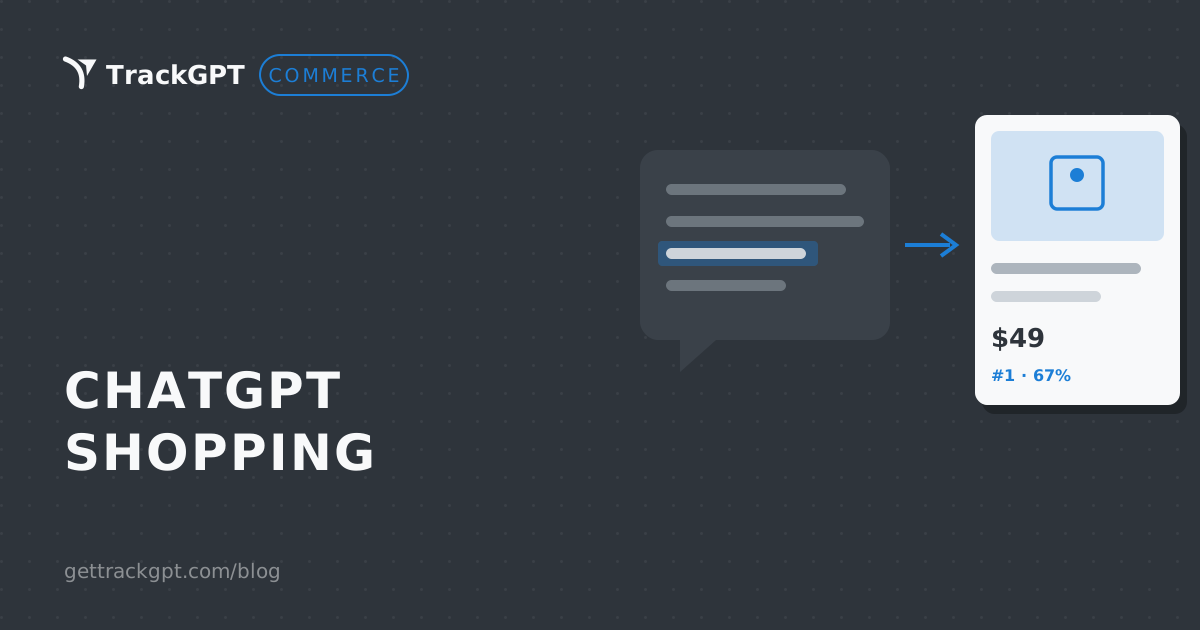
- Inline product recommendations. Ask ChatGPT a buying question and it returns a shortlist of products with reasoning, often as visual product cards showing image, price, and a link.
- Shopping research. A dedicated, more thorough mode where ChatGPT runs an extended, multi-step investigation — comparing options across price, availability, reviews, and specs — and returns a structured buyer's guide. It's powered by a version of GPT-5 mini that OpenAI trained specifically for shopping tasks.
- Instant Checkout. For eligible merchants and products, the shopper can complete the purchase inside ChatGPT, using the Agentic Commerce Protocol to run the cart, checkout, and payment.
The common thread: the shopper often gets to a decision — sometimes all the way to a paid order — without ever landing on a category page or running a Google search. The brand that gets named is the brand that gets considered.
The shopping assistant is not a search engine
Three differences change how you think about visibility.
It returns a few options, not a page of ten. A search results page has room for many listings and the searcher scans them. A ChatGPT answer names a handful. The long tail of "page one" doesn't exist; there's roughly the top three to five, and everyone else is invisible for that prompt. Scarcity raises the stakes of each mention.
It reasons in prose. Alongside each product ChatGPT writes why — "durable and well-reviewed for winter use." That sentence is assembled from reviews, listicles, and forum discussion, not just your product page. Your reputation across the web becomes copy the assistant reads aloud to the buyer.
Its answers are probabilistic. Ask the same shopping question twice and the shortlist can differ — different brands, different order. There is no fixed "rank," only a rate at which you appear across many samples. This single fact reshapes measurement, and we come back to it below.
How products get onto the shortlist
Two paths feed the assistant, covered in depth in our recommendations breakdown:
- The open web and organic Google Shopping. Profound's analysis found ChatGPT Shopping's products are almost fully explained by the top ~40 organic Google Shopping results — paid ads ignored. Your organic feed health and indexed product pages are table stakes.
- Direct product feeds. Merchants can supply OpenAI a structured feed (title, description, price, availability, images, eligibility flags) that gives the assistant authoritative, current product data. For Shopify stores this is delivered through Agentic Storefronts — see the integration guide.
Crucially, OpenAI is clear that these product results are organic and unsponsored: "not ads, nor influenced by any OpenAI partnerships." You cannot buy the recommendation ranking. What you can do is make your products easy to retrieve, complete to parse, and well-reviewed enough to recommend confidently — the everyday work of AI SEO for ecommerce and, more broadly, GEO for ecommerce.
What ecommerce brands can and can't control
Being honest about the boundary keeps you from wasting effort.
You control:
- Your product data — feed completeness, structured data, accurate price and availability, clean images.
- Your product copy — whether it speaks the specific, attribute-rich language ChatGPT's sub-queries match.
- Your off-site footprint — reviews, "best of" placements, and mentions on the sources ChatGPT cites for your category.
- Your eligibility — whether you've enabled the integration paths (Agentic Storefronts, feed, in-chat checkout).
You don't control:
- The exact answer. It's sampled and varies; no dashboard in ChatGPT shows "your rank."
- Placement for a fee. There's no paid slot in the organic product results today.
- The model's prior. For broad questions the assistant may lean on brands it "knows" from training data, and you can't retrain it.
- Which sub-queries it fires. You match them by being specific; you don't set them.
The takeaway isn't fatalism — it's focus. Spend on the controllable inputs, and measure the uncontrollable output rather than trying to command it.
Instant Checkout and what it means for your funnel
When a product is checkout-eligible, ChatGPT can complete the sale in-chat via the Agentic Commerce Protocol. For Shopify merchants using Agentic Storefronts, orders carry ChatGPT referral attribution, your branding and payment methods carry over, and — per Shopify — there are no extra transaction fees beyond standard processing. The upshot for your funnel: a share of demand now converts at the moment of recommendation, before the shopper ever reaches your site. That's efficient when you're the pick, and brutal when you're not, because there's no second-chance retargeting on a sale you never saw.
This is exactly why measurement can't be an afterthought. If a growing slice of category demand resolves inside ChatGPT, "are we the pick?" becomes a first-order revenue question.
Measuring your ChatGPT shelf
Because answers are probabilistic, you measure position as a mention rate over many samples, not a single lookup. The honest version reports four things: how often ChatGPT mentions you for a prompt, where you rank among the brands it does mention, which competitors it picks instead, and whether that's trending up or down over weeks — because one day's answer is noise.
That's the job TrackGPT does, ChatGPT-only for now. It samples your prompts daily, ranks you among all detected brands (not just the ones you track), classifies each prompt as Winning, Contested, Losing, or Invisible, and keeps the raw answer text as a receipt so every number points back to something you can read. It aggregates to weekly trends so a single lucky or unlucky answer doesn't move your read. It's monitoring only — it won't touch your store or your feed — but it turns an invisible shelf into a dashboard. The AI visibility platform is the full view; the ChatGPT rank tracker is the focused one.
Which prompts decide your ChatGPT revenue
Not every prompt is worth tracking, and the ones that matter aren't your brand name. Think in three buckets:
- Category shortlists — "best [category] for [use case]," "top [category] under $[price]." This is where high-intent, non-brand demand lives, and where being absent costs you customers who've never heard of you. These are your most important prompts.
- Comparison prompts — "[you] vs [competitor]," "alternatives to [competitor]." These catch shoppers already deciding. Being named — and named fairly — here is disproportionately valuable.
- Brand prompts — "is [your brand] any good," "[your brand] reviews." Lower volume, but a bad answer here (outdated info, a competitor recommended instead) directly undercuts buyers at the finish line.
A useful exercise: list the last twenty questions a customer might type on the way to buying what you sell, then map each to a bucket. That list — usually 20 to 50 prompts — is your ChatGPT scoreboard. Track those, not vanity terms, and you're measuring the answers that actually move revenue. The four-state read (Winning / Contested / Losing / Invisible) then tells you at a glance where to spend: defend the Winning, contest the Contested, and treat Invisible category prompts as the biggest untapped opportunity.
FAQ
Is ChatGPT shopping the same as ChatGPT ads?
No. As of mid-2026 the product recommendations are organic and unsponsored — OpenAI says they're "not ads, nor influenced by any OpenAI partnerships." The feed spec includes an is_ads_eligible flag, hinting paid formats could arrive later as a separate surface, but you can't currently pay into the organic results.
Do I need to be on Shopify to appear in ChatGPT shopping?
No. Any brand with a healthy organic web/Google Shopping presence can surface. But Shopify merchants get the integration paths (Agentic Storefronts, direct feed, in-chat checkout) largely handled for them, and Shopify even offers an Agentic plan for non-Shopify brands to list via its catalog. See the integration guide.
What's the difference between a ChatGPT mention and a ChatGPT sale?
A mention is being named in the answer; a sale via Instant Checkout is the purchase completing in-chat. A checkout-eligible, cited product can go straight to sale; a soft mention with no path relies on the shopper searching you out afterward. Both are worth tracking, but they're not the same event.
How many products does ChatGPT show per question?
Typically a shortlist of about three to five, not a full results page. That scarcity is why mention rate matters so much — there's little room, so being consistently present is the whole game.
Can I see my ChatGPT shopping performance in Shopify Admin?
Not natively as a visibility metric. Orders attributed to ChatGPT can show up in your analytics, but there's no built-in report for how often ChatGPT recommends you versus competitors. That gap is what a dedicated monitoring tool fills.
You can't improve what you can't see
ChatGPT shopping is a real shelf with real revenue moving across it, and unlike every shelf before it, it's invisible by default — no impressions, no rank, no report. Start a free TrackGPT trial and make it visible: see how often ChatGPT recommends your store, who it picks instead, and whether you're winning or losing the prompts your customers actually ask. You can't improve a shelf you can't see.